

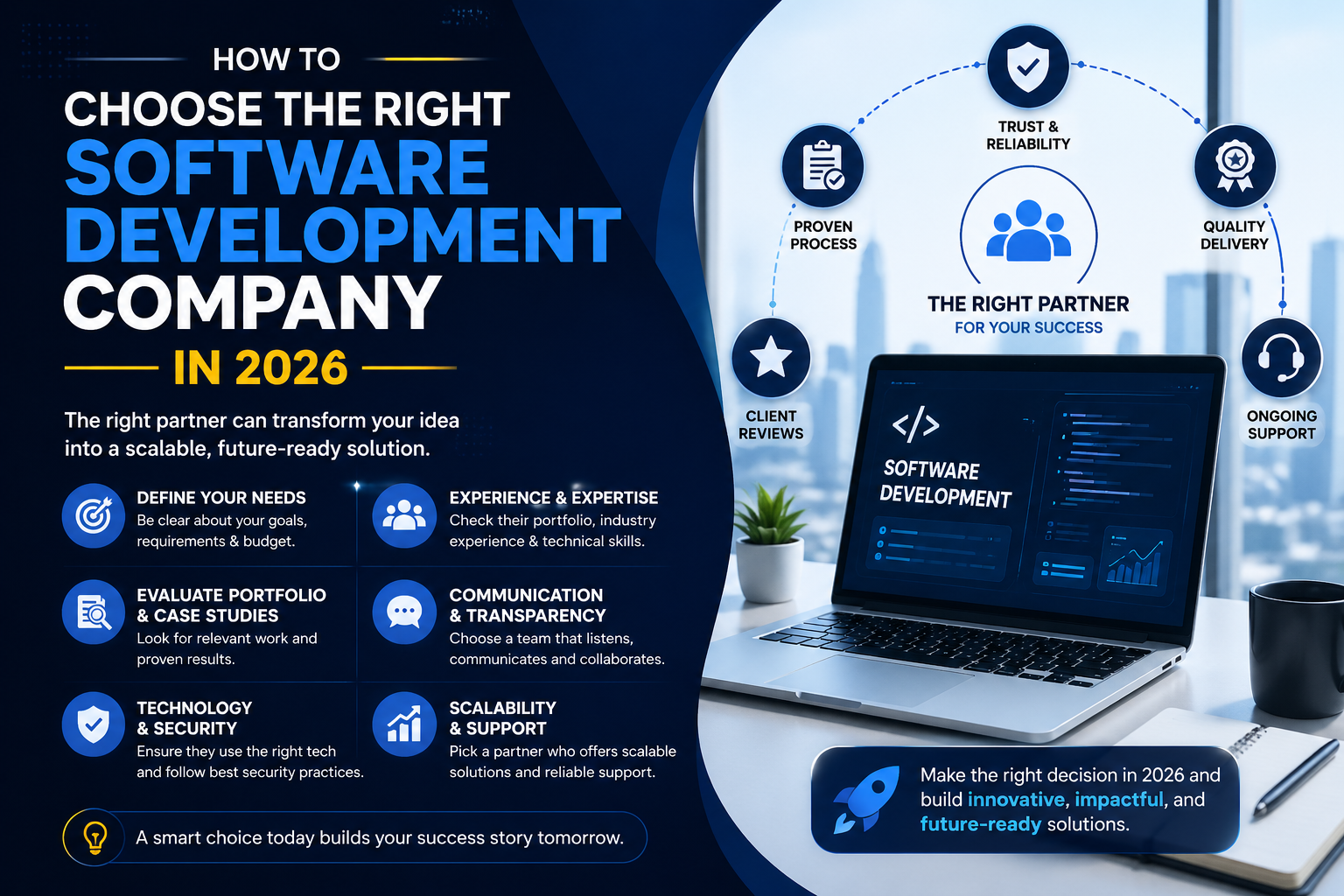
How to Choose the Right Software Development Company in 2026
The best software partner is not always the biggest agency or the cheapest quote. It is the team that understands your product, asks good questions, and can deliver the work without surprises.
If you are comparing vendors in 2026, focus on process, proof, communication, and ownership. Those four things usually tell you more than a polished sales deck ever will.
Quick checklist
- Look for relevant case studies, not just generic claims.
- Ask how they handle discovery, QA, and post-launch support.
- Make sure ownership, scope, and communication are written down clearly.
What to evaluate when comparing software companies
| What to check | Good sign | Red flag |
|---|---|---|
| Relevant experience | Similar projects and industries | Only generic portfolio examples |
| Discovery process | Clear scoping and planning | They want to start coding immediately |
| QA and testing | Testing is built into delivery | Testing is treated as optional |
| Communication | Regular updates and named owners | Unclear process and slow responses |
| Support after launch | Maintenance and handoff included | No plan for what happens next |
What the best partners do early
A strong partner should be able to explain your problem back to you in simple terms. If they understand the business outcome, they will usually make better product decisions later.
They should also ask more questions than you expect. Good discovery is a sign that the team cares about scope, feasibility, and long-term value.
- They ask about users, business goals, and success metrics.
- They identify risks before the build starts.
- They explain tradeoffs instead of promising everything.
- They give you a clear plan for delivery and review cycles.
Questions you should ask before signing
The fastest way to separate strong agencies from weak ones is to ask questions about process, not just price. A careful answer is often more valuable than a low quote.
- What similar projects have you completed?
- Who owns project management and communication?
- How do you handle QA and release readiness?
- What is included after launch?
- How do you prevent scope creep?
Common red flags
The most common mistake is choosing based on promises instead of evidence. If the proposal is vague, the process is unclear, or the team cannot explain how they work, that is usually a sign to slow down.
- No relevant case studies.
- No discovery phase.
- One price with no scope detail.
- No plan for QA or support.
- Communication that feels too sales-driven and not operational.
Frequently Asked Questions
Should I choose a local or remote company?
Choose the team that has the right process, proof, and communication. Location matters less than execution and trust.
Is the cheapest quote a bad sign?
Not always, but the cheapest quote often leaves out discovery, QA, or support, which can create more cost later.
How do I compare two proposals?
Compare scope, milestones, deliverables, ownership, QA, and post-launch support. Do not compare price alone.
What should a good proposal include?
It should clearly explain scope, timeline, assumptions, deliverables, communication cadence, and what happens after launch.
Need a practical estimate for your project?
Share your scope, timeline, and product goals with Wondercraftz and we will help you map the right next step.
Talk to Wondercraftz