

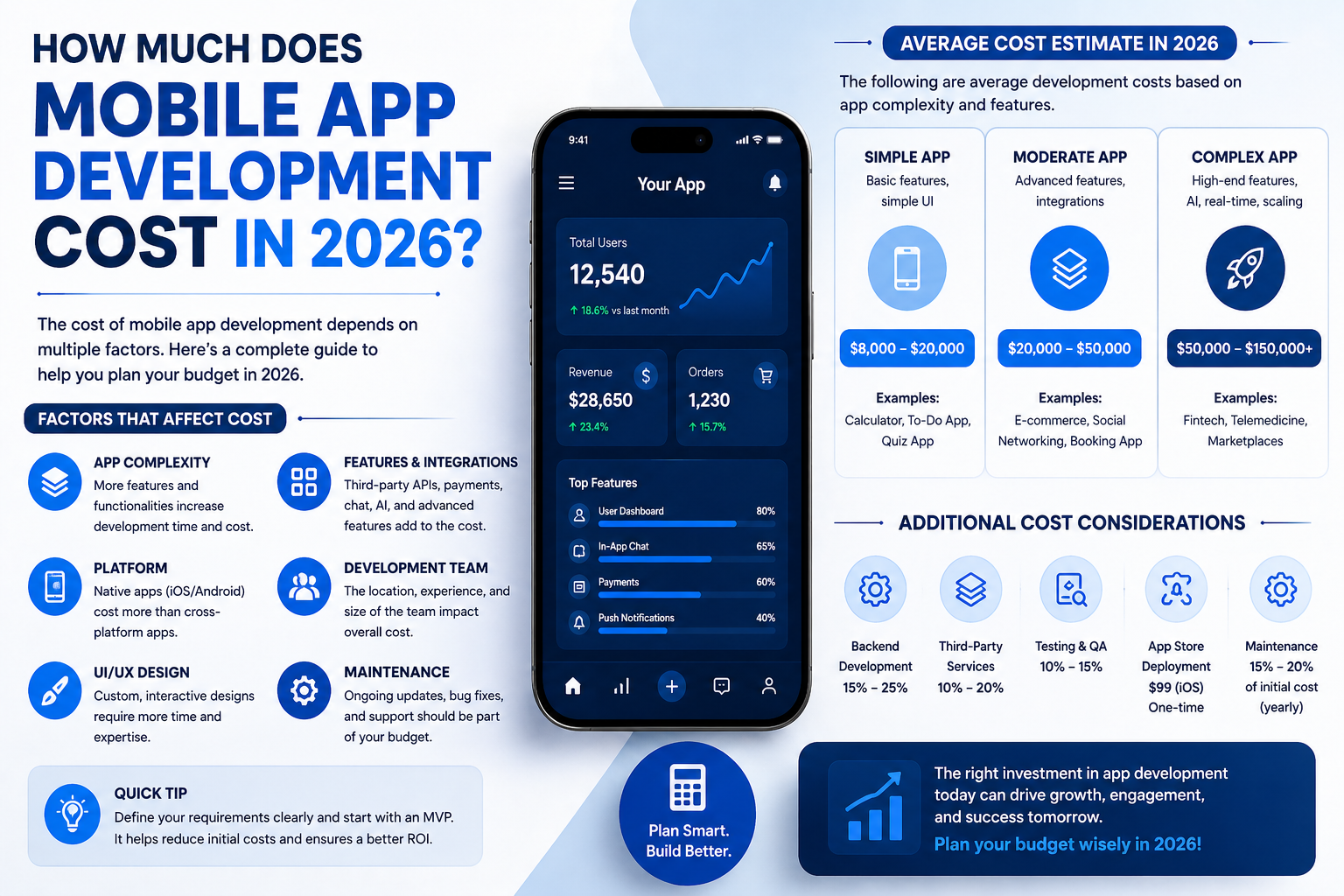
How Much Does Mobile App Development Cost in 2026?
App pricing changes quickly because mobile products carry more moving parts than most people expect. A polished UI, secure backend, app store submission, testing, analytics, and long-term maintenance all affect the final budget.
The smartest way to estimate app cost is to divide the work into product complexity, platform choice, and supporting infrastructure. That gives you a much clearer answer than asking for a single number too early.
Quick answer
- Simple MVP apps often start around $5,000 to $20,000.
- Mid-complexity consumer or business apps commonly land between $20,000 and $60,000.
- Feature-rich or enterprise apps can move from $60,000 to $150,000+ depending on scale.
Typical mobile app development cost ranges in 2026
| App type | Typical budget | Timeline | Best for |
|---|---|---|---|
| Simple MVP | $5,000 - $20,000 | 1 - 3 months | Early validation, internal pilots |
| Mid-complexity app | $20,000 - $60,000 | 3 - 6 months | Startups, service apps, marketplaces |
| Complex product app | $60,000 - $150,000 | 6 - 9 months | Multi-role apps, payments, custom logic |
| Enterprise app | $150,000 - $300,000+ | 9+ months | Large organizations, compliance-heavy systems |
What changes mobile app pricing the most?
The biggest decision is usually whether to build native apps for iOS and Android separately or use a cross-platform stack. Cross-platform can reduce cost and speed up delivery, but native development may be better for performance-heavy or device-specific experiences.
Backend complexity also matters. An app that only displays content is very different from one that needs authentication, payments, live updates, chat, dashboards, or third-party integrations.
- Platform choice: iOS, Android, or both.
- Design depth: simple screens vs custom product design.
- Backend and APIs: authentication, roles, notifications, and sync.
- QA load: device testing, edge cases, performance, and release support.
Hidden costs founders should plan for
A good app budget should include more than the first build. Many apps need ongoing support after launch because users, platforms, and business requirements keep changing.
- App store accounts and compliance work.
- Cloud hosting, storage, and API services.
- Ongoing bug fixes and feature updates.
- Analytics, event tracking, and crash reporting.
- Marketing assets and store listing optimization.
How to keep app costs under control
The most reliable way to control cost is to ship a focused MVP first. That means solving one clear problem, collecting feedback, and then scaling the product in phases instead of trying to build every feature at once.
Strong product planning matters just as much as engineering. If your flows, screens, and priorities are clear before development starts, the app will be easier to build and easier to maintain.
- Start with one primary use case.
- Prioritize the flows that create the most value.
- Reuse design components where possible.
- Plan QA and post-launch support from day one.
Frequently Asked Questions
Is cross-platform development cheaper?
Usually yes. Cross-platform lets one codebase serve both iOS and Android, which can reduce development time and maintenance effort.
What takes the longest in app development?
Backend logic, design revisions, QA cycles, and app store review readiness usually take the most time, especially for products with authentication or payments.
Can I build an app in phases?
Yes. Many of the best products start with an MVP and then add features after launch once user feedback is available.
Do I need maintenance after launch?
Yes. App stores, operating systems, APIs, and user expectations change, so ongoing maintenance is part of responsible app ownership.
Need a practical estimate for your project?
Share your scope, timeline, and product goals with Wondercraftz and we will help you map the right next step.
Talk to Wondercraftz